| Analog Superpowers : How Twentieth-century Technology Theft Built The National Security State |
| | ISBN: 9780226831220 | Price: 35.00 | | |
| Volume: | Dewey: 355/.0330730904 | Grade Min: | Publication Date: 2024-10-01 | |
| LCC: 2023-058452 | LCN: VF520.E67 2024 | Grade Max: | Version: | |
| Contributor: Epstein, Katherine C. | Series: | Publisher: University of Chicago Press | Extent: 368 | |
| Contributor: | Reviewer: William Alan Taylor | Affiliation: Angelo State University | Issue Date: March 2025 | |
| Contributor: | | | | |
 In this extraordinary book, Epstein (Rutgers Univ.) details the nexus between liberal capitalism and national security in both Britain and the United States through the analytical lens of two British inventors, Arthur Pollen and Harold Isherwood, their pioneering contribution to naval fire control, and the subsequent efforts to control this pivotal invention. Along the way, Epstein reveals much about a myriad of interconnected matters, including naval technology, legal doctrine, state power, business law, networked warfare, intellectual property, patent secrecy, and the free market. Deeply researched, meticulously documented, and vividly written, Analog Superpowers is a remarkable achievement of modern history. Epstein uses cogent analysis of specifics to deliver vital insights about broad themes of great import. In today's age of great power competition and rapid technological change related to machine learning, artificial intelligence, and cyber security, it is enlightening to consider previous epochs wherein technology presented challenges and opportunities among the nations vying for the innovation capable of producing military advantage. Epstein has done a valuable service to the profession by delivering such a relevant and instructive history. A wide range of readers--including those interested in military, technology, and international history, among many others--will greatly benefit from reading this important work.Summing Up: Essential. Advanced undergraduates through faculty; professionals; general readers. |
| Counterintelligence At Its Core : Assessing And Preventing Foreign Espionage |
| | ISBN: 9781962551489 | Price: 105.00 | | |
| Volume: | Dewey: | Grade Min: | Publication Date: 2025-05-20 | |
| LCC: 2024-052401 | LCN: JF1525.I6R55 2025 | Grade Max: | Version: | |
| Contributor: Riehle, Kevin P. | Series: | Publisher: Lynne Rienner Publishers | Extent: vii, 211 | |
| Contributor: | Reviewer: Daniel McIntosh | Affiliation: emeritus, Slippery Rock University of Pennsylvania | Issue Date: December 2025 | |
| Contributor: | | | | |
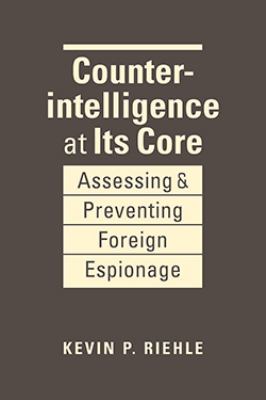 Perhaps it's not surprising that almost no one publishes books on counterintelligence, which reflects a confusion within the discipline: is counterintelligence threat mitigation, analysis, or a specialized activity? In fact, it's all of the above. The emphasis varies with the agency. This book is written by an expert with a wide range of experience: practitioner and academic, participant and observer, a man who can see the big picture without losing sight of the details within the "wilderness of mirrors." It's valuable, but not for beginners. Riehle focuses on counterintelligence from an American perspective on international competition. A much-desired second volume might compare states, users, and functions. But what this current volume does, it does well: showing how to prevent an adversary from gaining decision advantage. This is done offensively and defensively at every point in the intelligence cycle. Riehle, a career counterintelligence analyst, has written a valuable book for anyone involved in counterintelligence and for outsiders who want an introduction to a wide world few people--inside or out--will ever see.Summing Up: Essential. Graduate students, faculty, two-year technical program students, professionals, and general readers. |
| Illusions Of Control : Dilemmas In Managing U.s. Proxy Forces In Afghanistan, Iraq, And Syria |
| | ISBN: 9780231210126 | Price: 140.00 | | |
| Volume: | Dewey: 322.42 | Grade Min: | Publication Date: 2024-07-30 | |
| LCC: 2023-057164 | LCN: UA13.G37 2024 | Grade Max: | Version: | |
| Contributor: Gaston, Erica L. | Series: Columbia Studies in Terrorism and Irregular Warfare Ser. | Publisher: Columbia University Press | Extent: 424 | |
| Contributor: | Reviewer: Matthew D. Crosston | Affiliation: Bowie State University | Issue Date: June 2025 | |
| Contributor: | | | | |
 This wonderfully written book asks an incredibly important question that does not get enough academic, diplomatic, and military scrutiny: Is it possible to regulate irregular forces? This starting point, from an author who has spent time in the field embedded with the relevant actors involved in this delicate and extremely complex process, could very well be the entirety of future conflict in international relations. So many modern wars today--at least the ones fought by the great world powers and contenders to hegemony--are organized, constructed, and ultimately executed in de facto proxy formats. The West prefers to avoid scrutiny of its own activities in this format. With expressive writing and hard-earned field experience and data, this work investigates not only how this state of affairs has developed (looking in detail at Afghanistan, Iraq, and Syria) but also at the more important "problem area" innate to the endeavor. Namely, are we really successful in keeping checks and balances and accountability on informal groups conducting formal war maneuvers in our name? As one might expect, the results are uneven. Investigating why and wondering how to improve it makes this work essential.Summing Up: Essential. General readers through faculty; professionals. |
| Landing The Paris Climate Agreement : How It Happened, Why It Matters, And What Comes Next |
| | ISBN: 9780262049146 | Price: 32.95 | | |
| Volume: | Dewey: | Grade Min: | Publication Date: 2024-10-08 | |
| LCC: 2023-057517 | LCN: K3585.5.A42015S74 | Grade Max: | Version: | |
| Contributor: Stern, Todd | Series: | Publisher: MIT Press | Extent: 280 | |
| Contributor: | Reviewer: Robert E. O'Connor | Affiliation: National Science Foundation | Issue Date: May 2025 | |
| Contributor: | | | | |
 Stern (Brookings Institution) served as special envoy for climate change at the Department of State from January 2009 to April 2016. This case study details the seven years of negotiations that concluded with 195 nations agreeing to a framework for addressing climate change. The tale includes shifting alliances, a secret agreement with China, and last-minute deals that produced an international agreement to set renewable targets for meeting the challenge of climate change. The book concludes with a chapter explaining the ongoing importance of the Paris Agreement, despite the willful ignorance of political leaders, such as Donald Trump, of the scientific findings regarding climate change. Stern's book is a remarkable achievement for being both an entertaining story of how diplomacy actually works and a scholarly tome that embodies the highest standards of scholarship. Stern does not exaggerate the stakes of the struggle to address climate change but calmly recounts how diplomats integrated the geological threats from climate change (which make international action necessary) with political challenges (which make international action difficult). An important book.Summing Up: Essential. All readership levels. |
| Spetsnaz : A History Of The Soviet And Russian Special Forces |
| | ISBN: 9780700637911 | Price: 34.99 | | |
| Volume: | Dewey: 356/.1670947 | Grade Min: | Publication Date: 2024-12-12 | |
| LCC: 2024-008525 | LCN: UA776.S64B85 2024 | Grade Max: | Version: | |
| Contributor: Bukkvoll, Tor | Series: Modern War Studies | Publisher: University Press of Kansas | Extent: 306 | |
| Contributor: | Reviewer: Christopher C. Lovett | Affiliation: Topeka Public Schools | Issue Date: May 2025 | |
| Contributor: | | | | |
 NATO and the Pentagon have been concerned about Soviet and Russian special operators for years. Bukkvoll, a research fellow at the Norwegian Defense Research Establishment, enlightens readers about Russian special operations troops. Bukkvoll relies on memoirs to detail the history of Spetsnaz from 1951 to the current struggle in Ukraine. He traces the early beginnings of Spetsnaz, when commanders recruited ideologically driven troops from the Soviet Army to form special operations companies. Since then, Russians have used special forces in Syria, Chechnya, Afghanistan, and the current war in Ukraine. When Spetsnaz first evolved, the Soviet military establishment was concerned with the possibility of a conflict with NATO and the US. Spetsnaz was designed for direct action, special reconnaissance, and military assistance. In 2014, Spetsnaz units were used to seize Crimea. Putin and his operatives believed that taking the rest of Ukraine was possible in 2022, embarking on an ill-advised conflict. Often, political leaders miscalculate their opponents and the consequences of military action. Spetsnaz units and the Russian military have paid a dear price for such wishful thinking. Bukkvoll's Spetsnaz is a masterpiece in scholarship and a tour de force for understanding Russian special operations forces today.Summing Up: Highly recommended. All readership levels. |
| Technology And The Rise Of Great Powers : How Diffusion Shapes Economic Competition |
| | ISBN: 9780691260334 | Price: 99.95 | | |
| Volume: 222 | Dewey: 338.064 | Grade Min: | Publication Date: 2024-08-20 | |
| LCC: 2023-049961 | LCN: HC79.T4D545 2024 | Grade Max: | Version: | |
| Contributor: Ding, Jeffrey | Series: Princeton Studies in International History and Politics Ser. | Publisher: Princeton University Press | Extent: 280 | |
| Contributor: | Reviewer: Scott Waalkes | Affiliation: Malone University | Issue Date: March 2025 | |
| Contributor: | | | | |
 This brilliant book makes two landmark contributions to scholarship in international relations. First, it is one of the first major works to consider how the rise of "general purpose technologies," including artificial intelligence (AI), could contribute to the rise of major powers. Second, it revises the traditional view of how "leading sectors" contributed to the rise of major powers. To take the most famous example, the prevailing view is that the steam engine in the Industrial Revolution contributed to the rise of Great Britain by launching the iron and textile industries. But Ding (George Washington Univ.) argues that the diffusion of technologies into "general purpose technologies" is a far more influential process. Following an introduction and a theoretical chapter are chapters on the First, Second, and Third Industrial Revolutions. A sixth chapter engages in a statistical analysis of the diffusion of software engineering skills and computerization, followed by a seventh chapter on US-China competition and the role of AI (interestingly, it predicts potential US dominance). A brief conclusion pulls together the argument nicely. This is one of the most important books in international relations to be published in years.Summing Up: Essential. Advanced undergraduates through faculty; professionals. |
| The Dark Patch : The Structure Of War And The Rise Of The West |
| | ISBN: 9780300270686 | Price: 40.00 | | |
| Volume: | Dewey: 355.009 | Grade Min: | Publication Date: 2024-10-22 | |
| LCC: 2024-935191 | LCN: U27.M8 2024 | Grade Max: | Version: | |
| Contributor: Murray, Williamson | Series: | Publisher: Yale University Press | Extent: 488 | |
| Contributor: | Reviewer: David M Corlett | Affiliation: University of Virginia | Issue Date: April 2025 | |
| Contributor: | | | | |
 Few authors can explain and synthesize the evolution of Western warfare in a monograph, but the late Murray (emer., Ohio State Univ.) succeeded admirably. Murray argues that while war's fundamentally unpredictable nature never changes, its character has continuously evolved in the West through five military-social revolutions and accompanying revolutions in military affairs since 1500. The First Military-Social Revolution (1500), centered on the creation of the modern state and disciplined militaries, was accompanied by the gunpowder revolution. The second (1750) combined the technology and production modes of the Industrial Revolution, and the third (1789) saw the ideological mobilization of society, as demonstrated in the French Revolution. In the second half of the 19th century, the Fourth Military-Social Revolution combined the advances of its predecessors with parallel revolutions in transportation, communication, agriculture, and the advent of modern weaponry. The Fifth (and current) Military-Social Revolution is rooted in scientific and computing advances, melding brute weaponry with computer guidance and artificial intelligence. As Murray argues, while Western states sought "the magical elixir of decisive battle" through centuries of technological and social advancements, they instead entrenched attrition as the king of battle (p. 19).Summing Up: Highly recommended. Undergraduates through faculty; professionals. |
| The Political Army : How The U.s. Military Learned To Manage The Media And Public Opinion |
| | ISBN: 9780231219778 | Price: 140.00 | | |
| Volume: | Dewey: 355.3420973 | Grade Min: | Publication Date: 2025-03-11 | |
| LCC: 2024-036411 | LCN: UH703.C76 2025 | Grade Max: | Version: | |
| Contributor: Crosbie, Thomas | Series: | Publisher: Columbia University Press | Extent: 280 | |
| Contributor: | Reviewer: Bradford A. Wineman | Affiliation: Marine Corps University | Issue Date: July 2025 | |
| Contributor: | | | | |
 The Political Army analyzes the United States Army's comprehensive and deliberate campaign to manage and frequently manipulate the national media from 1939 to 2000. Crosbie (Royal Danish Defence College) traces the Army's media management from its extemporaneous beginnings to its institutionalized professionalization, driving its rise to political prominence. Army leaders recognized the importance of media management, understanding that controlling information had become crucial in modern warfare. In this endeavor, the Army distinguished itself as an adept learning organization from both victories (WW II, Gulf War) and failures (1950s New Look, Vietnam Tet Offensive). It continually adapted its approach to the press, evolving its strategies over time to ensure robust public and domestic political support. Crosbie, a military sociologist, expertly frames this relationship within the broader context of the free press's role in a democratic government and its application of violence. These two new arguments of the Army's flexible competence and the media's role as both a willing and unwilling instrument in armed conflict make this monograph a truly groundbreaking study in civil-military relations and 20th-century US history.Summing Up: Highly recommended. General readers through faculty; professionals. |
| Youth And Sustainable Peacebuilding |
| | ISBN: 9781526176202 | Price: 140.00 | | |
| Volume: | Dewey: 303.660835 | Grade Min: | Publication Date: 2024-06-25 | |
| LCC: | LCN: JZ5538.Y6 2024 | Grade Max: | Version: | |
| Contributor: Berents, Helen | Series: | Publisher: Manchester University Press | Extent: 288 | |
| Contributor: Bolten, Catherine | Reviewer: Joseph P. Smaldone | Affiliation: Georgetown University | Issue Date: March 2025 | |
| Contributor: Mcevoy-Levy, Siobhan | | | | |
 The study of conflict and its resolution inevitably must contend with, if not focus on, the multifaceted roles of youth as disenchanted activists, rebels, combatants, victims, peacemakers, or other lesser-known categories of agency. Fortunately, the editors and contributors to this volume have served up a remarkably comprehensive overview and critical assessment of this ubiquitous and vexing problem. Youth categories are heterogeneous and fluid, and individuals may transition between and among them throughout the conflict spectrum. This volume's 14 chapters are arranged in three parts, focusing on states and "youth problems," institutional contexts of engagement with young people, and several case studies of youth-led, peace-building efforts. The editors call on scholars and practitioners to rethink their conceptualizations and operations to better align with the nuances, complexities, and possibilities for youth to participate constructively and meaningfully in sustainable peace building. They conclude with nine recommendations to achieve these goals. Recommended for academic and practicing professionals in the war/peace space and for university libraries and collections supporting international affairs programs. An outstanding contribution to the literature.Summing Up: Highly recommended. Advanced undergraduates through faculty; professionals. |