| Cartographies Of Exclusion : Anti-semitic Mapping In Medieval England |
| | ISBN: 9780271097466 | Price: 109.95 | | |
| Volume: | Dewey: 941.00492400902 | Grade Min: | Publication Date: 2024-11-19 | |
| LCC: 2024-012572 | LCN: DS146.G7C378 2024 | Grade Max: | Version: | |
| Contributor: Mittman, Asa Simon | Series: | Publisher: Pennsylvania State University Press | Extent: 232 | |
| Contributor: | Reviewer: Leon Yacher | Affiliation: emeritus, Southern Connecticut State University | Issue Date: November 2025 | |
| Contributor: | | | | |
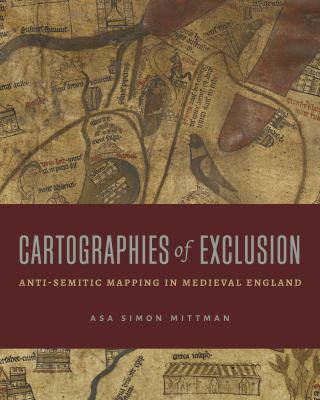 This is an important, timely, and unique contribution! Mittman (art and art History, California State Univ., Chico) analyzes numerous medieval maps to gain a greater understanding of anti-Semitism in England during that period. One cannot avoid relating this to current events taking place worldwide. Reading this detailed examination of the cartography of Christendom is a challenge to the emotions, as it brings to life a sense of belonging in a perilous and unsettling world. Sadly, the book leaves a heavy feeling of how members of a dominant group can vilify and control actions against those chosen for exclusion by dehumanizing them for their differences. Maps can be effective in providing the kind of information that can persuade a percipient to conclude representations that support or defy truth. Mittman examines the less obvious yet subtle details found in medieval period maps that relay heavily negative messages about Jews. The author's seminal research goes a long way toward filling the existing lacunae in the research frontier. For uninitiated readers, each chapter's contents provide marginalized perspectives. Complemented by abundant photos, maps, and a rich bibliography, this must-read volume covers topics that remain underresearched.Summing Up: Highly recommended. General readers, advanced undergraduates through faculty, and professionals. |
| Confronting The Irish Past : The 1912-1923 Decade In Light Of The 1998 Good Friday Agreement |
| | ISBN: 9781839991103 | Price: 110.00 | | |
| Volume: | Dewey: 941.50821 | Grade Min: | Publication Date: 2024-09-10 | |
| LCC: 2024-936399 | LCN: DA960.C6 2024 | Grade Max: | Version: | |
| Contributor: Murphy, Samus | Series: | Publisher: Anthem Press | Extent: 246 | |
| Contributor: | Reviewer: Kenneth Campbell | Affiliation: Monmouth University | Issue Date: October 2025 | |
| Contributor: | | | | |
 Drawing on writers such as Hannah Arendt and Margaret MacMillan regarding the uses and abuses of history, Murphy (Loyola Univ. Chicago) offers a significant contribution to that literature: an indispensable reflection on how such ideas apply to Irish history. A philosopher by training, Murphy brings a distinct lens to analyzing the past, one grounded in the role of morality in historical interpretation. He argues that, even judged by the value systems of their time, the perpetrators of violence during the Irish Civil War should have recognized that their actions would harm their own cause. Likewise, nationalists failed to account for the fact that a significant portion of the population did not share their vision, and that ousting the British would not, by itself, achieve a unified Ireland. At the same time, Unionists should have understood that commemorating events deeply offensive to the Catholic majority would intensify nationalist resentment. Murphy also includes a profound chapter on "the ethics of social memory," offering specific moral guidelines and questions for when and how historical events should be commemorated. This book is both challenging and necessary for scholars of Irish history and historical memory.Summing Up: Essential. Advanced undergraduates through faculty. |
| Rebecca's Country : A Welsh Story Of Riot And Resistance |
| | ISBN: 9781915279743 | Price: 24.00 | | |
| Volume: | Dewey: 942.9081 | Grade Min: | Publication Date: 2025-01-14 | |
| LCC: | LCN: DA722.J6 2024 | Grade Max: | Version: | |
| Contributor: Jones, Rhian E. | Series: | Publisher: Gwasg Prifysgol Cymru / University of Wales Press | Extent: 256 | |
| Contributor: | Reviewer: Jody Taylor Watkins | Affiliation: Purdue University | Issue Date: July 2025 | |
| Contributor: | | | | |
This comprehensive and engrossing volume is a welcome addition to the literature on the Rebecca movement in Wales itself, as well as broad-based radical movements for change more generally. Moving beyond the standard image of Rebeccaism as an essentially agrarian movement targeting tollgates due to the unreasonable financial burden they posed for farmers, Jones explores its other "forgotten or underplayed" dimensions. In her foreword, she compares Rebeccaism to the 21st-century Occupy movement for its broad approach to various aspects of inequality and injustice, among them the poor laws, the workhouses, the plight of single mothers, and worker's rights issues. The tollgates were "only a final straw and not the entire burden." The Commission of Enquiry in 1843, however, handed the Rebeccaites only a partial victory by choosing to focus on the tollgates over the more complex set of economic, political, and social problems in which they were embedded. Jones has done a masterful job combining historical research with stories about a number of movement participants and detractors, officials, and observers. These engaging and frequently exciting stories bring the movement to life.Summing Up: Highly recommended. General readers through faculty; professionals. |
| The Fall : Last Days Of The English Republic |
| | ISBN: 9780300211498 | Price: 65.00 | | |
| Volume: | Dewey: 941.06/3 | Grade Min: | Publication Date: 2024-06-18 | |
| LCC: 2024-932815 | LCN: DA425.R4 2024 | Grade Max: | Version: | |
| Contributor: Reece, Henry | Series: | Publisher: Yale University Press | Extent: 464 | |
| Contributor: | Reviewer: Douglas R. Bisson | Affiliation: Belmont University | Issue Date: April 2025 | |
| Contributor: | | | | |
 Reece (emer., Univ. of Oxford, UK) has rescued the fall of the English Republic from the "long backwards shadow" cast by the Restoration (p. 2). He demolishes the thesis that the civilian government of the Republic was doomed to fail after the death of Oliver Cromwell because of an army committed to "godly reform" (p. 17). Rather, it was a failure of statesmanship that led to the collapse of the Protectorate in May 1659, the dismissal of the recalled Rump Parliament in October, and the wreckage of the Committee of Safety in December. These events were the prologue to the military coup carried out by General Monck the following year. Taking center stage is that "man of disobliging carriage," Sir Arthur Hesilrige, who staunchly opposed one-man rule and resented the army leadership for dissolving Parliament in 1653 (p. 180). The maladroitness of senior army commanders Fleetwood, Disbrowe, and Lambert proved that politics is too important to be left to the generals. The relentless focus on contingency and individual responsibility makes for a gripping narrative. Reece closes with the rueful observation that restoring the traditional civilian rule of King, Lords, and Commons required a professional soldier's dismissal of two parliaments.Summing Up: Essential. Advanced undergraduates through faculty. |