| Africa's Soft Power : Philosophies, Political Values, Foreign Policies And Cultural Exports |
| | ISBN: 9781032008356 | Price: 180.00 | | |
| Volume: | Dewey: 327.6 | Grade Min: | Publication Date: 2021-05-24 | |
| LCC: 2020-057540 | LCN: JZ1773.T385 2021 | Grade Max: | Version: | |
| Contributor: Tella, Oluwaseun | Series: Global Africa Ser. | Publisher: Taylor & Francis Group | Extent: 226 | |
| Contributor: | Reviewer: Claude E. Welch | Affiliation: emeritus, University at Buffalo, SUNY | Issue Date: October 2022 | |
| Contributor: | | | | |
 This well-documented analysis concentrates on the soft power of Egypt, Kenya, Nigeria, and South Africa. Dating back to 1990 and identified largely with American political scientist Joseph Nye, soft power connotes a country's non-coercive capabilities that engender other states' attraction, admiration, and aspirations. Tella (Univ. of Johannesburg, South Africa), who has published extensively on the concept, seeks to de-Americanize soft power. After reviewing relevant literature, he outlines the soft power capabilities of Brazil, China, India, and Russia. Successive chapters examine these capabilities in Nigeria, South Africa, Egypt, and Kenya. Tella does an excellent job delineating the four countries' specific strengths, and each state follows a distinctive concept. Omoluabi in Nigeria draws from a Yoruba ideal that everyone should strive for: to develop a sense of belonging to the community--a significant lesson for governance. Ubuntu beliefs characterize South Africa, according to which individuals are deeply woven into social structures based on collective ways of being. Harambee in Kenya similarly emphasizes collective participation within a community to resolve needs, using its own resources. Finally, resilient Pharaonism in Egypt draws from the state's unique experience as Africa's oldest civilization.Summing Up: Highly recommended. Advanced undergraduates through faculty. |
| Amkoullel, The Fula Boy |
| | ISBN: 9781478013273 | Price: 124.95 | | |
| Volume: | Dewey: 966.2301092 | Grade Min: | Publication Date: 2021-08-20 | |
| LCC: 2020-057981 | LCN: DT551 | Grade Max: | Version: | |
| Contributor: B, Amadou Hampt | Series: | Publisher: Duke University Press | Extent: 398 | |
| Contributor: Garane, Jeanne | Reviewer: Elizabeth S Schmidt | Affiliation: emeritus, Loyola University Maryland | Issue Date: May 2022 | |
| Contributor: | | | | |
 Penned by a renowned Malian writer, ethnographer, and historian whose life spanned the 20th century, this gem of a book recounts the life and times of the author and his ancestors in precolonial and colonial West Africa. Marked by the strong oral storytelling tradition of the Fula ethnic group, Ba's elegantly written tale is historically informative and expertly translated by Garane (Univ. of South Carolina). Using his family chronicle as a lens, Ba offers readers unique insights into Fula religious beliefs, social hierarchies, marriage practices, and gender relations. He highlights the importance of family and friendship, the dynamics of patron-client relations, and the shifting tides of confrontation and collaboration with French colonizers and culture. His compelling account underscores the absence of a clear line between the precolonial and colonial periods, as Fula customs and practices both adapted to and influenced the new realities. Particularly notable are the strong role women played in both public and private life and the everyday forms of resistance and accommodation to the exigencies of colonial rule. A powerful agent for deeper understanding and a significant contribution to the literature, this is a must-have volume for scholars, students, and academic libraries.Summing Up: Essential. Lower-division undergraduates through faculty; professionals. |
| Healing Knowledge In Atlantic Africa : Medical Encounters, 1500-1850 |
| | ISBN: 9781108491259 | Price: 103.00 | | |
| Volume: | Dewey: 610.96 | Grade Min: | Publication Date: 2021-02-04 | |
| LCC: 2020-034141 | LCN: R651.K37 2021 | Grade Max: | Version: | |
| Contributor: Kananoja, Kalle | Series: Global Health Histories Ser. | Publisher: Cambridge University Press | Extent: 320 | |
| Contributor: | Reviewer: Ty M. Reese | Affiliation: Univ. of North Dakota | Issue Date: March 2022 | |
| Contributor: | | | | |
 Kananoja (Univ. of Oulu, Finland) has produced an important, insightful work on the place of African healing and knowledge in the larger Atlantic world. Though African healing in the Atlantic has been explored within the American plantation complex, it has been largely ignored in Africa, though Kananoja skillfully illustrates its important role there. Taking a more global approach, he explores the flow of medical knowledge into and out of West Africa--specifically West-Central Africa, Sierra Leone, and the Gold Coast--and the place of cross-cultural interaction within these exchanges. As Europeans arrived in a West African environment seen as a "white man's grave," they came to rely on local healers for treating disease, injuries, and other concerns. This reliance on African healers and knowledge counters traditional notions of knowledge creation and the common stereotype that local healers were sorcerers. Instead, the book focuses on how people shared knowledge and the larger consequences of those connections and documents the similarities among the medical knowledge and practices of West Africa, Europe, and the Americas. This similarity is most vividly seen in the use of plants as the basis for treatments.Summing Up: Highly recommended. Advanced undergraduates through faculty. |
| Knowing Women : Same-sex Intimacy, Gender, And Identity In Postcolonial Ghana |
| | ISBN: 9781108495905 | Price: 103.00 | | |
| Volume: | Dewey: 306.766309667 | Grade Min: | Publication Date: 2021-01-21 | |
| LCC: 2020-025740 | LCN: HQ75.6.G4D36 2021 | Grade Max: | Version: | |
| Contributor: Dankwa, Serena O. | Series: African Identities: Past and Present Ser. | Publisher: Cambridge University Press | Extent: 320 | |
| Contributor: | Reviewer: Catherine Higgs | Affiliation: University of British Columbia | Issue Date: May 2022 | |
| Contributor: | | | | |
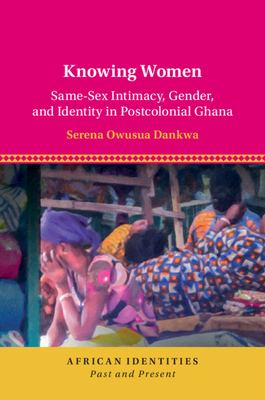 This remarkable book deserves a wide audience beyond African studies and gender and women's studies. Theoretically subtle and accessible and beautifully written, it asks readers to reconsider their assumptions about intimate relationships in Africa and to embrace complexity. Dankwa's subjects are the anonymized "knowing women" involved in same-sex relationships in early-21st-century southern Ghana. Most live in the capital Accra; some live in a smaller city. They include young female footballers (soccer players), a female car mechanic, and older market women who function in some cases as "sugar mothers," offering intimate privacy to younger women living in poverty. Many are married to men, though their partners are often distant or absent and tolerant of their wives' friends. Most have children (more essential to culture than marriage), and most hide their sexual/relationship preferences, but they are not completely invisible. They are conscious of risk, and those who are activists focus on broad social and economic human rights over narrower sexual rights. Rather than imposing North Atlantic definitions of lesbian, gay, or queer, Dankwa (Univ. of Bern, Switzerland) asks readers to consider seniority/age and relatedness/kinship as ways to understand women's lives in their cultural contexts.Summing Up: Highly recommended. General readers, advanced undergraduates through faculty, and professionals. |
| Negotiating Patriarchy And Gender In Africa : Discourses, Practices, And Policies |
| | ISBN: 9781793642042 | Price: 135.00 | | |
| Volume: | Dewey: 305.31096 | Grade Min: | Publication Date: 2021-08-26 | |
| LCC: 2021-021712 | LCN: HQ1090.7.A35N44 2021 | Grade Max: | Version: | |
| Contributor: Uchendu, Egodi | Series: | Publisher: Lexington Books/Fortress Academic | Extent: 352 | |
| Contributor: Uchendu, Egodi | Reviewer: Gloria Emeagwali | Affiliation: Central Connecticut State University | Issue Date: June 2022 | |
| Contributor: Edeagu, Ngozi | | | | |
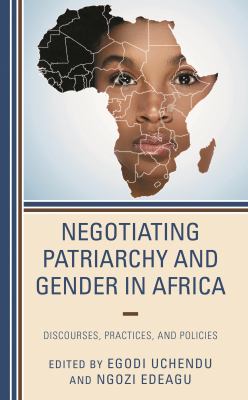 This text is a major contribution to women's studies in Africa and elsewhere. Scholars from Nigeria, Ghana, Cameroon, Kenya, South Africa, Zimbabwe, and the US are among the authors that Uchendu (Univ. of Nigeria) and Edeagu (Univ. of Bayreuth, Germany; AE-FUNAI, Nigeria) have brought together in this illuminating, scholarly, multidimensional, and multidisciplinary work. Over four sections--"Gender Discourse and Domination"; "Women, Work, and Exploitation"; "Women in Power and Male Dominance"; and "Policy Implementation"--the contributing authors examine patriarchal structures of dominance and systemic hindrances to full equality. They find that institutionalized patriarchy has been the norm in various spheres, including everyday speech, and has been reflected in film, literature, and politics. A study of Nollywood points to the uncomfortable environment women composers face in the film music industry. In politics, women elected to parliamentary and advisory positions have not been able to escape abusive and misogynistic indignities either. Nevertheless, challenges have been posed to patriarchal dominance from various sources, including a garment women typically wear, the khanga, which has been employed as a visual and symbolic challenge to male chauvinism. Projects such as the Kenyan Dads and Daughters and mechanisms such as the Maputo Protocol are among the harbingers of hope discussed in the collection.Summing Up: Highly recommended. General readers through faculty; professionals. |
| The Great Upheaval : Women And Nation In Postwar Nigeria |
| | ISBN: 9780821423974 | Price: | | |
| Volume: | Dewey: | Grade Min: | Publication Date: | |
| LCC: | LCN: | Grade Max: | Version: | |
| Contributor: Byfield, Judith A | Series: | Publisher: Ohio University | Extent: | |
| Contributor: | Reviewer: Toyin O. Falola | Affiliation: University of Texas | Issue Date: April 2022 | |
| Contributor: | | | | |
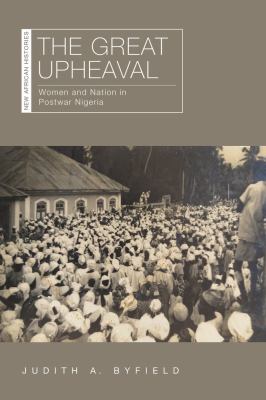 This brilliant book is set in the modernizing city of Abeokuta among the Yoruba of southwestern Nigeria. The trigger for the crisis that forms the study's central focus was a tax revolt in 1947. By July 1948, Ademola II, the king and sole native authority figure, had abdicated his throne and gone into exile for three years. The series of protests and resulting abdication became "the Great Upheaval," around which Byfield (Cornell Univ.), a preeminent historian of Abeokuta, organizes her data and draws her conclusions. Led by the indomitable Funmilayo Ransome-Kuti, market women and a few educated women combined forces to generate the protests. Known as the Abeokuta Women's Union, the organization leveraged a catalog of grievances--corruption in city government, official high-handedness, and taxation--to mobilize thousands of women to demand the termination of the sole native authority, the representation of women in city governance, and the abolition of taxes on women. These women's activism serves as the entry point to understand the formation of the Abeokuta nation, the agency of gender, the role of political activism, and the enduring challenges of institutions in a colonized space.Summing Up: Highly recommended. Advanced undergraduates through faculty; professionals. |
| Thomas Sankara : A Revolutionary In Cold War Africa |
| | ISBN: 9780253053756 | Price: 90.00 | | |
| Volume: | Dewey: 966.25052092 | Grade Min: 17 | Publication Date: 2021-03-02 | |
| LCC: 2020-026114 | LCN: DT555.83.S36P48 2021 | Grade Max: | Version: | |
| Contributor: Peterson, Brian J. | Series: | Publisher: Indiana University Press | Extent: 350 | |
| Contributor: | Reviewer: Robert I. Rotberg | Affiliation: Harvard University | Issue Date: January 2022 | |
| Contributor: | | | | |
 In a Francophone West Africa dominated during the Cold War by legacy luminaries loyal to France and friendly to French business interests, Thomas Sankara was a striking departure. A young, pensive, military man acquainted with Marxism and democratic thought, he helped overthrow the elected president of the Republic of Upper Volta in 1983. Rather than accumulate power and riches as the new president, Sankara proved revolutionary in his political preferences and strikingly principled in his deeds. He gave his country the postcolonial name of Burkina Faso, tried to turn it into a deliberative democracy, and initiated a war against corruption. He was charismatic, at first wildly popular both at home and abroad, and much more a man of the people than his predecessors and successors within Burkina Faso and far beyond. As his friend Jean-Pascal Ouedraogo commented after Sankara's assassination in 1987, in a plot led by Blaise Compaore, Sankara's one-time friend and subsequent rival, all Africa mourned the loss of Sankara because he "was a simple, honest man, who worked hard to peacefully build his country." This is an exemplary biography of an Africa president revered for his integrity and gift of inspired leadership.Summing Up: Highly recommended. Advanced undergraduates, graduate students, and professionals. |