| Aid To Armenia : Humanitarianism And Intervention From The 1890s To The Present |
| | ISBN: 9781526142207 | Price: 130.00 | | |
| Volume: | Dewey: 361.26094756 | Grade Min: | Publication Date: 2020-09-08 | |
| LCC: | LCN: | Grade Max: | Version: | |
| Contributor: Laycock, Joanne | Series: Humanitarianism: Key Debates and New Approaches Ser. | Publisher: Manchester University Press | Extent: 216 | |
| Contributor: Piana, Francesca | Reviewer: Khachig Tololyan | Affiliation: formerly, Wesleyan University | Issue Date: September 2021 | |
| Contributor: | | | | |
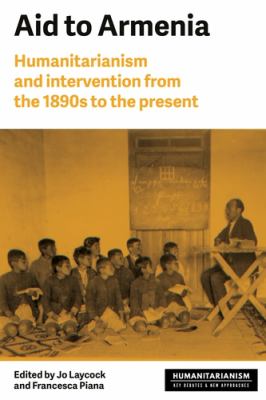 This is the 11th volume in the timely and consistently well-edited series "Humanitarianism: Key Debates and New Approaches." Ten essays, an important introduction, an afterword, and an epilogue present and analyze over a century of humanitarian attempts to help Armenia and Armenians when they were ruled by Ottoman Turkey, Tsarist Russia, and the Soviet Union, or after independence. Some of the best essays are specific and focused, such as Sossie Kasbarian's "Refuge in the 'Homeland,'" about Syrian Armenians seeking shelter and humanitarian help due to the ongoing catastrophe in Syria. Others offer accounts of and draw lessons from countries contributing aid, as in Heitor Loureiro's surprising narrative of attempts to engage Brazil. Vahe Tachjian's thoughtful account of contributions from a major philanthropic organization of the Armenian diaspora helpfully directs attention to non-state sources of assistance. Not all essays can be enumerated, but Asya Darbinyan's rich and compact examination of Russian imperial responses to humanitarian catastrophe achieves a particularly complex task well, pointing out differences between assistance coming from first responders, institutions, and then states. The editors instructively summarize the wealth of actions and discourses that together constitute not just Armenian but all modern humanitarianism in this essential collection.Summing Up: Essential. Advanced undergraduates through faculty. |
| Atlantic Wars : From The Fifteenth Century To The Age Of Revolution |
| | ISBN: 9780190860455 | Price: 45.99 | | |
| Volume: | Dewey: 355.00918210903 | Grade Min: | Publication Date: 2020-06-19 | |
| LCC: 2019-054870 | LCN: D214.P55 2020 | Grade Max: | Version: | |
| Contributor: Plank, Geoffrey | Series: | Publisher: Oxford University Press, Incorporated | Extent: 336 | |
| Contributor: | Reviewer: John Rankin | Affiliation: East Tennessee State University | Issue Date: July 2021 | |
| Contributor: | | | | |
 Focused on a multitude of actors, this wide-ranging analysis of warfare in the early modern Atlantic world skillfully weds the exploration of warfare with a broad, easy-to-read synthesis. Plank (Univ. of East Anglia, UK) begins by explaining the development and extent of European naval power within the Atlantic world. The second section focuses on armies and the limitations of engaging in land-based campaigns. Plank asserts that unlike naval warfare, where innovation and capital investments proved decisive, European armies struggled to harness the advantages of horses, firearms, and other technologies. He further maintains that while naval warfare reinforced cultural and physical barriers, land-based campaigns were capable of facilitating cross-cultural learning and cooperation, ultimately allowing for military alliances. The final section, a chronological evaluation of Atlantic warfare, examines how the Atlantic world developed from the 15th century to the Age of Revolution. Overall, Atlantic Wars offers an exciting and interesting way to learn about the Atlantic world. With its broad approach, subject matter, interesting examples, and clear and precise language, Atlantic Wars would be useful for novice readers just being introduced to this conceptual space, and for experts who work on military history and/or the Atlantic world.Summing Up: Highly recommended. Lower-division undergraduates through faculty. |
| Detestable And Wicked Arts : New England And Witchcraft In The Early Modern Atlantic World |
| | ISBN: 9781501751059 | Price: 145.00 | | |
| Volume: | Dewey: 364.188 | Grade Min: | Publication Date: 2020-10-15 | |
| LCC: 2019-050798 | LCN: BF1576.M69 2020 | Grade Max: | Version: | |
| Contributor: Moyer, Paul B. | Series: | Publisher: Cornell University Press | Extent: 294 | |
| Contributor: | Reviewer: Matthew Reardon | Affiliation: West Texas A&M University | Issue Date: September 2021 | |
| Contributor: | | | | |
 Monographs on witchcraft in early America abound. Seemingly every aspect of the topic--medical, religious, socioeconomic, gender, legal, material culture--has received sustained analysis. Yet, until this volume occult crime had surprisingly lacked an Atlantic interpretation. Here, the story of witchcraft in Puritan New England from 1640 to 1670 is placed in a transatlantic context to demonstrate its ties to the greater 17th-century English Atlantic. This approach reveals that Puritan colonists shared beliefs about witchcraft with fellow English subjects, and that crises in the other parts of the empire, such as the English Civil War, could provoke witchcraft outbreaks in New England. Additionally, this work is to be lauded for its very accessible synthesis of the vast extant literature on witchcraft in the English Atlantic, with individual chapters detailing how black magic intersected with class, religion, gender, and the law. Deeply researched, crisply composed, and highly engaging, this is arguably the best introductory survey available on witchcraft in the early modern English Atlantic. A work of synthesis and innovative scholarship, it will be of interest to neophytes and experts alike.Summing Up: Highly recommended. General readers through faculty. |
| Humanitarianism In The Modern World : The Moral Economy Of Famine Relief |
| | ISBN: 9781108493529 | Price: 103.00 | | |
| Volume: | Dewey: 363.8526 | Grade Min: | Publication Date: 2020-07-23 | |
| LCC: 2020-009071 | LCN: HV553.G657 2020 | Grade Max: | Version: | |
| Contributor: Brewis, Georgina | Series: | Publisher: Cambridge University Press | Extent: 320 | |
| Contributor: Werther, Steffen | Reviewer: Jeremy McMaster Rich | Affiliation: Marywood University | Issue Date: March 2021 | |
| Contributor: Gotz, Norbert | | | | |
 This fascinating comparative study examines the dynamics and economic organization of international humanitarian responses to three cases of famine: Ireland in the 1840s, the Soviet Union in the early 1920s, and Ethiopia in the mid-1980s. The authors innovatively reframe E. P. Thompson's theoretical concept of moral economy and apply it to donor organizations. Their methodology also offers useful insights for researchers exploring the dynamics of historical change in humanitarian action. The authors bring together philosophical, political, and medical conceptions of need, effective methods of providing relief, and relief as a cause to attract donors. This study does not merely summarize major historical events but also effectively uses an impressive amount of archival research to reconstruct the moral economy of aid in all three cases. One of the many noteworthy subjects covered is the matter of changing methods of accounting in transparency organization. Another topic deserving credit is the changing role of individual donors, especially regarding North American and European responses to hunger in Ethiopia. This very highly recommended book is an indispensable contribution to the growing study of historical change in humanitarian organizations.Summing Up: Highly recommended. General readers, upper-division undergraduates through faculty, and professionals. |
| Jews And Crime In Medieval Europe |
| | ISBN: 9780814345597 | Price: 89.99 | | |
| Volume: | Dewey: 940/.049240902 | Grade Min: | Publication Date: 2020-11-30 | |
| LCC: 2020-943887 | LCN: BM180.S46 2021 | Grade Max: | Version: | |
| Contributor: Shoham-Steiner, Ephraim | Series: | Publisher: Wayne State University Press | Extent: 460 | |
| Contributor: | Reviewer: Steven Theodore Katz | Affiliation: Boston University | Issue Date: September 2021 | |
| Contributor: | | | | |
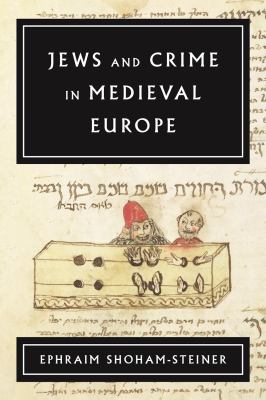 This work of importance analyzes a subject rarely considered in the study of medieval Jewish history, eruditely considering the span of literature and archival records relevant to a wide-ranging understanding of this topic. Acknowledging that medieval Jewry included not only geniuses like Maimonides but also thieves and murderers, the volume begins by setting out the relevant methodological issues, in chapters such as "The Concepts of Crime and Punishment in Medieval Europe," and "The History of Jewish Medieval Crime." It then reviews the issue of stealing, both by and from Jews, and the punishment for this crime as understood by rabbinic law and also by major medieval figures like Rabbi Gershon ben Judah of Mainz (d. 1028) and by the Christian courts. This comparative aspect is particularly informative. Shoham-Steiner (Ben-Gurion Univ. of the Negev, Israel) then analyzes the more serious matter of murder, concentrating on murder within the Jewish community. The last chapter deals with the highly original subject of Jewish women as both criminals and victims, focusing especially on the topics of prostitution and "Violence in the Domestic Sphere." This chapter in particular is a fundamental scholarly contribution.Summing Up: Highly recommended. All levels. |
| Red Money For The Global South : East-south Economic Relations In The Cold War |
| | ISBN: 9780367244750 | Price: 180.00 | | |
| Volume: | Dewey: | Grade Min: | Publication Date: 2020-03-10 | |
| LCC: 2019-049967 | LCN: HC243.5.T74 2020 | Grade Max: | Version: | |
| Contributor: Trecker, Max | Series: Routledge Studies in Modern History Ser. | Publisher: Routledge | Extent: 244 | |
| Contributor: | Reviewer: Steven G Jug | Affiliation: Baylor University | Issue Date: July 2021 | |
| Contributor: | | | | |
 Trecker's informative monograph spans the breadth of the Cold War from the 1960s through the 1980s. His study engages every part of the Global South with varying attention based on how many projects and funds operated in a region through the auspices of the Council for Mutual Economic Assistance (CMEA), a Soviet agency. Trecker (Leibniz Institute for Contemporary History, Germany) organizes his study thematically with a general chronological progression, and draws from the archives of CMEA as an institutional source for tracking historical East-South economic activity. The author makes a persuasive case for economic cooperation, not military hardware transfers or soft power athletic exchanges, as the central interaction between countries of the Eastern Bloc and those of the Global South. Shared political interests bolstered the trade arrangements as postcolonial sovereignty drove most new governments in the Global South and thus suited the emancipatory rhetoric of the East. When global trade dynamics began to shift in the 1980s, the Eastern Bloc states, not those of the Global South, lost ground in relative terms. Trecker's study thus provides essential new insights into the dynamics of the middle and late Cold War.Summing Up: Highly recommended. Lower-division undergraduates through faculty; professionals. |
| Revolutionary Europe : Politics, Community And Culture In Transnational Context, 1775-1922 |
| | ISBN: 9781350020009 | Price: 120.00 | | |
| Volume: | Dewey: 940.2535 | Grade Min: | Publication Date: 2020-02-06 | |
| LCC: | LCN: | Grade Max: | Version: | |
| Contributor: Murray-Miller, Gavin | Series: | Publisher: Bloomsbury Publishing Plc | Extent: 368 | |
| Contributor: | Reviewer: Mark A. Mengerink | Affiliation: Lamar University | Issue Date: February 2021 | |
| Contributor: | | | | |
 Murray-Miller (Cardiff Univ., UK) offers a sweeping narrative and analysis of the revolutionary tradition in the long 19th century. He rejects the Marxist and structuralist approaches to explaining revolutions and instead argues that the separate revolutionary events in Europe were both unique and closely related. Each revolution had distinct features unique to the particular context, but was part of a broader revolutionary tradition "reinforced through processes of community building and transnational cultural exchange throughout the period" (p. 3). Throughout his study, the author analyzes how revolutionaries sought to redefine sovereignty and social unity in the attempt to "manufacture new social relations and forms of collective authority" (p. 3). Murray-Miller illustrates the local, national, imperial, and transnational influences on revolutionary activity, an approach that demonstrates well the author's grasp of the scholarship and his keen ability to synthesize it into a new interpretation. This well-written study is essential.Summing Up: Essential. All levels. |
| The World : A Brief Introduction |
| | ISBN: 9780399562396 | Price: 28.00 | | |
| Volume: | Dewey: | Grade Min: | Publication Date: 2020-05-12 | |
| LCC: 2019-044618 | LCN: JZ1329.5.H33 2020 | Grade Max: | Version: | |
| Contributor: Haass, Richard | Series: | Publisher: Penguin Publishing Group | Extent: 400 | |
| Contributor: | Reviewer: Sanford Robert Silverburg | Affiliation: emeritus, Catawba College | Issue Date: April 2021 | |
| Contributor: | | | | |
 Haass (president of the nonpartisan Council on Foreign Relations) is a long-term public servant, and he is particularly knowledgeable about national security affairs. He is known for his concern about the total lack of awareness of world affairs on the part of the average person. The present book is, at its core, a world history textbook for high school civics or history AP classes. Part 1, "The Essential History," begins with the Thirty Years' War and the signing of the treaties of Westphalia (1648), which created the nation-state system, and continues through WW I, WW II, the Cold War, and post-Cold War period to the present. In section 2, "Regions of the World," Haass reviews events and political dynamics by generally recognized regions of the globe: Europe, East Asia and the Pacific, South Asia, the Middle East, Africa, and the Americas. Part 3, "The Global Era," discusses presently recognized global concerns such as globalization, terrorism and counterterrorism, climate change, and a whole swath of other interesting subjects. The last part, "Order and Disorder," is the most challenging because the subjects are complex and go to the heart of international politics. Readers will come away from this book well informed about history and current events.Summing Up: Essential. Lower- and upper-division undergraduates, students in two-year programs, general readers. |
| Wandering Jews : Global Jewish Migration |
| | ISBN: 9781557539984 | Price: 25.99 | | |
| Volume: | Dewey: 909/.04924 | Grade Min: | Publication Date: 2020-12-15 | |
| LCC: 2020-947293 | LCN: DS134 | Grade Max: | Version: | |
| Contributor: Gold, Steven J. | Series: Jewish Role in American Life: an Annual Review Ser. | Publisher: Purdue University Press | Extent: 234 | |
| Contributor: | Reviewer: Jeffrey Haus | Affiliation: Kalamazoo College | Issue Date: August 2021 | |
| Contributor: | | | | |
 This collection contains seven essays on Jewish immigration by scholars from disciplines including history, sociology, and literature. Like earlier studies, the different chapters here explore both the experiences of Jewish immigrants and their impact on the communities they have joined in both the US and Europe. The contributors discuss these issues on novel terms. Some study immigrant groups that have not received extensive attention (e.g., Iranian and Latin American Jews); others define immigrant groups by their professional activities (e.g., academics and other highly skilled workers). Even those Jewish immigrants from more studied groups--post-WW II displaced persons and late-19th-century Eastern European immigrants to Germany--come under a different analytical lens. This eclectic combination of methods yields both an intriguing body of new information and an instructive view of the changing contours of Jewish migration studies. The book will serve students and instructors in search of new approaches to a subject that remains vibrant and relevant.Summing Up: Highly recommended. Lower-division undergraduates through faculty. |